The average e-commerce AI project takes 9 months to show ROI. This one took 6 weeks — three focused agents, a $2,400/month infrastructure bill, and $31,000 in monthly savings.
The average e-commerce AI project takes 9 months from kickoff to measurable ROI. Most teams spend the first 3 months evaluating vendors, the next 3 integrating, and the final 3 waiting to accumulate enough data to declare success. The one described here took 6 weeks. It wasn't because the technology was exceptional. It was because the scope was narrow, the metrics were agreed before a line of code was written, and each agent targeted a problem with a dollar amount already attached to it.
Starting numbers: 3.2% conversion rate, 71% cart abandonment, 18% return rate. After 6 weeks: 4.3% conversion, 63% abandonment, 14% returns. Total monthly savings: $31,000. Infrastructure cost: $2,400/month. Here is exactly how it happened.
Step 0: Attach Dollar Amounts Before Writing Code
Cart abandonment at 71%: with 4,200 monthly sessions and a $67 average order value, recovering 8 percentage points meant $22,500/month in recaptured revenue. Return rate at 18%: each return cost $14 in processing, reshipping, and restocking. Dropping to 14% on 800 monthly orders meant $4,500/month saved. Search conversion: 23% of sessions used search, but only 2.1% of those led to a purchase. Closing half the gap to industry average meant $4,000/month in additional revenue. Total addressable improvement: $31,000/month. That number became the infrastructure budget ceiling.
Agent 1: SearchBoost — Semantic Product Search
The existing search was keyword-based. A user searching 'running shoes for wide feet' got results ranked by keyword frequency, not semantic relevance. Products tagged 'wide fit athletic footwear' didn't appear. SearchBoost replaced the keyword index with hybrid retrieval: dense embeddings (text-embedding-3-small) plus BM25, with results reranked by a cross-encoder trained on 6 months of click-through data.
Stack: Pinecone for the vector store, Shopify Storefront API for catalog sync, a 4-hour re-embedding pipeline for new products. Time to build: 2.5 weeks. Result: search-to-purchase conversion went from 2.1% to 2.8% in the first 30 days, then to 3.4% as the reranker accumulated click data. Final improvement: +34% over baseline.
Agent 2: CartGuard — Abandonment Prediction and Recovery
CartGuard doesn't send a discount email to everyone who abandons. It predicts which abandoners are likely to return anyway (sends nothing) versus which are at permanent-loss risk (sends a targeted message). The prediction model uses 12 signals: time on checkout page, number of checkout visits in session, device type, traffic source, cart value vs average order value, login status, and 5 behavioral signals from during the session.
Logged-in users with high-value carts who spent 90+ seconds on checkout but didn't complete: 68% conversion on recovery email. Anonymous users who bounced in under 20 seconds: 3% recovery rate — not worth the send cost. CartGuard only fires for the first group. The recovery email leads with the specific cart items plus a single friction-removal message. Average recovery email conversion: 12%, versus the industry average of 4% for cart abandonment emails.
Agent 3: ReturnPredictor — Stop Bad Orders Before They Ship
22% of returns came from 8% of customers. ReturnPredictor identifies high-return-risk orders before fulfillment using: historical return rate for the customer, whether the order contains above-average-return items (size-sensitive, color-sensitive products), whether it's a duplicate of a recently returned order (bracket buying), and cart composition signals.
When ReturnPredictor flags an order as high-risk, it doesn't cancel it. It triggers a proactive intervention: a size guide confirmation email for apparel, a product detail video for electronics. 41% of flagged orders result in customer confirmation or modification — and those modified orders return at 4% versus 22%. Return rate went from 18% to 14% in 6 weeks. At 800 monthly orders and $14 per return: $3,840/month saved.
Why This Order Matters
Build SearchBoost first — it only needs the product catalog, no customer data. Build CartGuard second — it needs 30 days of session data to train. Build ReturnPredictor last — it needs order history. Reverse the order and you'll wait 60 days for training data before you can ship Agent 2.
The Full Stack and Real Monthly Costs
SearchBoost: Pinecone ($70/month), text-embedding-3-small (OpenAI), Shopify Storefront API, AWS Lambda for reranking inference. CartGuard: Segment ($150/month) for event collection, a logistic regression model on AWS SageMaker ($290/month), Customer.io ($150/month) for email delivery, Shopify Webhooks. ReturnPredictor: Shopify Orders API, XGBoost classifier (not an LLM), Shopify Flow for intervention trigger. Total infrastructure: $2,400/month including $1,660/month in 4 hours/week of maintenance engineering time.
Week-by-Week Timeline
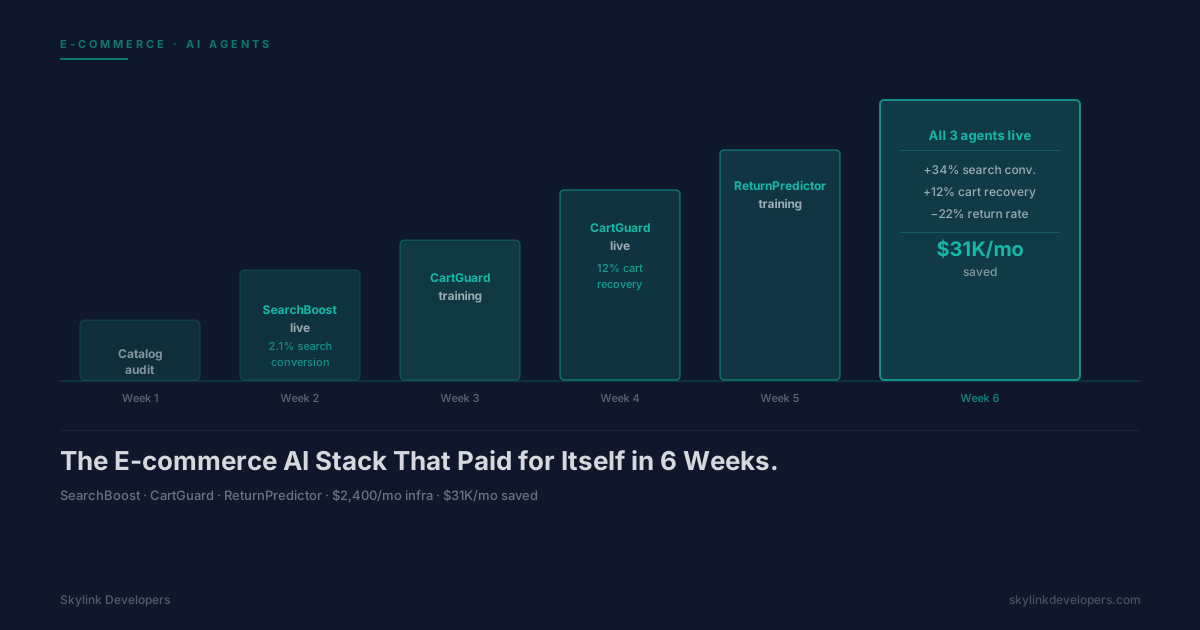
Week 1: Product catalog audit. 340 products had missing or inconsistent tags. Fixed tagging. Set up Pinecone index and initial embedding pipeline. Week 2: SearchBoost live in production. Instrumented click-through tracking. Baseline: 2.1% search conversion. Week 3: Segment instrumentation for cart events. Trained initial CartGuard model on 90 days of historical session data. Week 4: CartGuard live. First recovery emails sent. Week 5: ReturnPredictor training on 6 months of order history. Identified top 8 return-risk signals. Built Shopify Flow integration. Week 6: ReturnPredictor live. All three agents running. First full-week data: +18% search conversion, 9% cart recovery rate, 12% reduction in flagged-order returns.
Frequently Asked Questions
CartGuard's model needs at least 2,000 orders of historical data to be useful. Below that, use a rule-based fallback: send a recovery email to anyone who spends 90+ seconds on checkout without completing. SearchBoost works at any size — even 500 products benefit from semantic search. ReturnPredictor needs 500+ returns to train on, so it's only viable at $500K+ GMV.
Frequently Asked Questions
Yes. The architecture is platform-agnostic. Shopify-specific components (Storefront API, Webhooks, Flow) have equivalents on WooCommerce (REST API, action hooks) and BigCommerce (Catalog API, webhooks). Expect 20–30% longer implementation time on non-Shopify platforms due to less mature tooling.
Frequently Asked Questions
For the initial build: yes, or a 6–8 week contractor. For ongoing maintenance: SearchBoost re-embeddings are automated. CartGuard needs model retraining every 60 days (2–4 hours). ReturnPredictor needs retraining quarterly. Total ongoing: 6–8 hours/month — manageable by a generalist engineer with some ML exposure.
Six weeks, three agents, $2,400/month in infrastructure. The lesson isn't that AI is fast. It's that narrow scope, pre-agreed metrics, and a sequencing plan that accounts for data dependencies get you to production faster than any technology choice you'll make.